Aurora 101
What the northern lights are, why they glow, and how to catch them
New to aurora chasing? Start here. Everything you need is on one page, from the Sun to your first photo.

01 · What is it
The aurora, in one paragraph
The Sun constantly streams electrically charged particles into space. This is the solar wind. When they reach Earth, our planet's magnetic field steers them toward the poles, where they crash into oxygen and nitrogen high above the ground. Each collision makes an atom glow for an instant. Billions at once become the shimmering curtains we call the aurora: borealis in the north, australis in the south.
02 · How it works
From the Sun to the sky
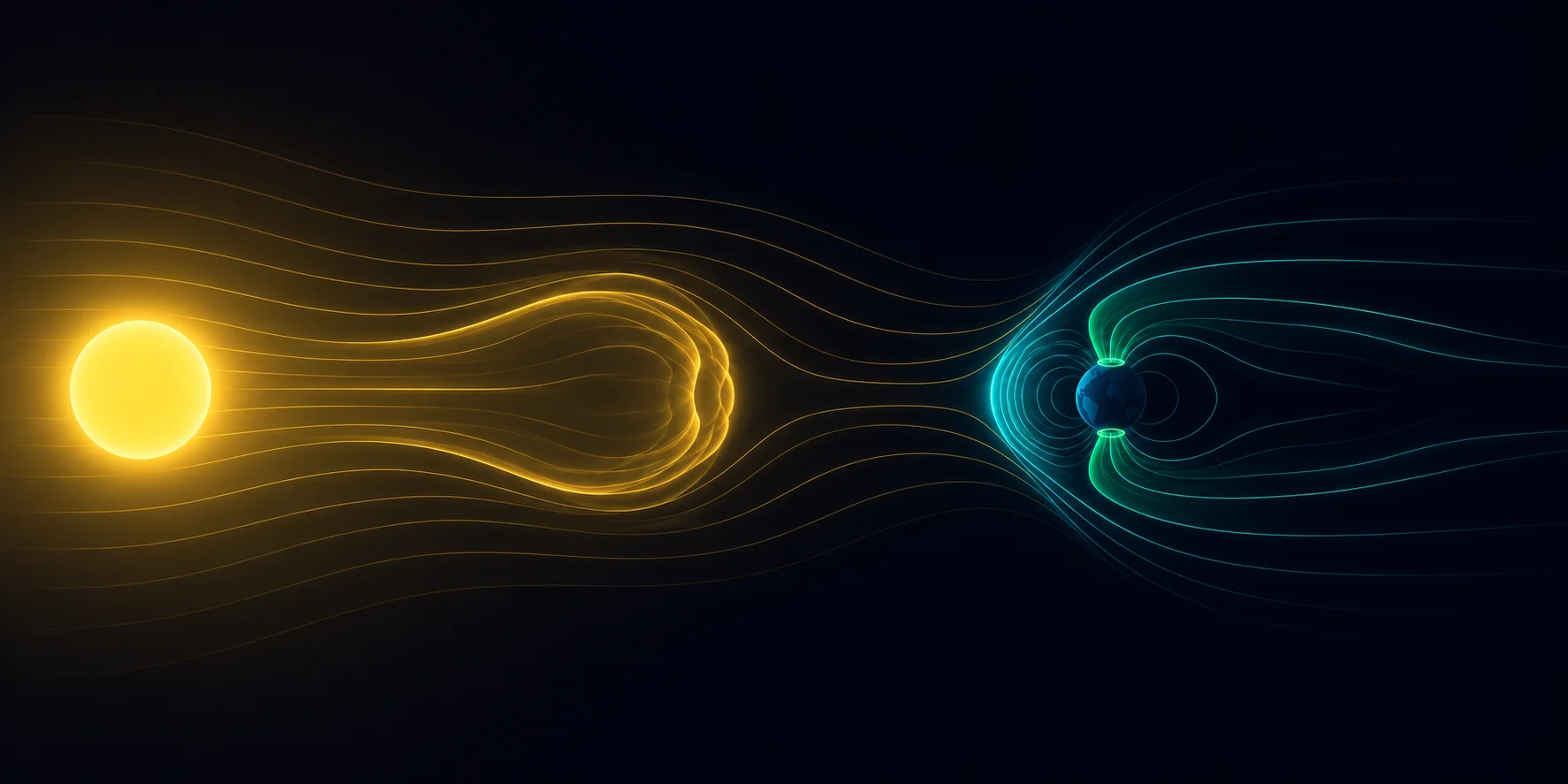
1 ·It starts at the Sun. Two solar drivers matter to a chaser. Coronal mass ejections (CMEs) are billion-tonne eruptions of magnetised plasma that reach Earth one to three days after launch and power the biggest storms. Coronal holes are dark regions that send out fast solar-wind streams and tend to come back every ~27 days as the Sun rotates.
2 ·Earth's magnetic shield, and its doorway. The solar wind can't just pour in, because the magnetosphere deflects most of it. The key is the magnetic field the wind carries with it. When its north–south component, Bz, tips southward, it links up with Earth's northward field and magnetic reconnection opens an energy pathway. Southward Bz is the best real-time sign that a display is coming. That's why the Activity page charts it live.
3 ·The release. That energy doesn't trickle in. It builds up in Earth's stretched magnetotail, then snaps back in bursts called substorms, sending particles down the field lines into two rings around the magnetic poles: the auroral ovals. This is why the aurora surges and fades in waves rather than glowing steadily, and why a quiet sky can erupt within minutes.
4 ·The glow. Arriving particles collide with oxygen and nitrogen between roughly 80 and 400 km up, knocking them into excited states. As each atom or molecule relaxes, it gives off light of a precise colour. That is where the palette comes from.
03 · The colours
Colour = gas + altitude
Which colour you see depends on which gas is struck and how high up it happens. The ordering is real physics: nitrogen blues sit lowest, oxygen green in the middle, oxygen red on top.
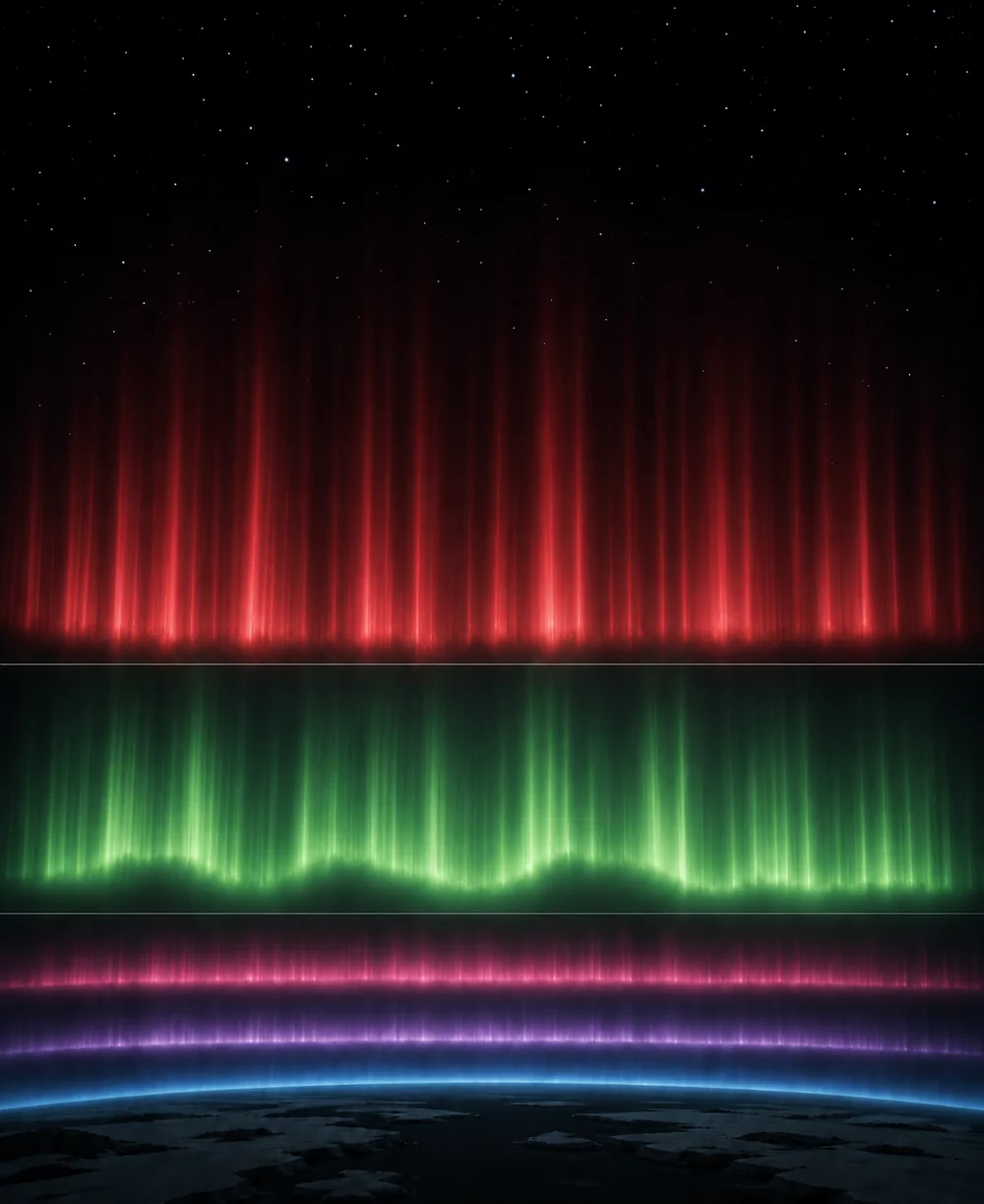
- RedO · 630.0 nm200–400+ km
A "forbidden" oxygen transition that takes ~110 seconds. Lower down, a collision steals the energy first. Red only survives in thin high air, which is why red = high = strong storm.
- GreenO · 557.7 nm100–240 km
The classic curtain, the brightest and most common. A fast oxygen transition that survives at denser altitudes, right where our eyes are most sensitive.
- Pink / magentaN₂~90–100 km
Molecular nitrogen along the fast-moving lower edge of active curtains. A live sign the display is getting stronger.
- BlueN₂⁺ · 427.8 nm< 100 km
Ionised molecular nitrogen, reached only by the most energetic particles. Often easier for a camera than the naked eye.
- Purple / violetN₂⁺ + Otops & edges
A blend of nitrogen blues with high red oxygen. After dusk, sunlit curtain tops can also look violet while the ground is dark.
Every colour above is identified by shape, name and altitude, never by colour alone.
04 · When & where
Four boxes to tick
Geomagnetic activity. The stronger it is, the farther from the poles the aurora reaches. The classic yardstick is the Kp index (0–9). But Kp is a 3-hour global average, so it lags. For right now, the better tools are real-time solar wind (speed, density and above all southward Bz) and the OVATION oval model. Both are live on the Activity page.
Darkness. You need real night. A bright Moon washes out faint displays, and high-latitude summers barely get dark at all. Aurora Core computes true darkness windows for each location. Darker skies also mean more visible detail.
Clear sky. Cloud blocks everything, and even thin high cirrus smears a faint display. Use the satellite imagery and the hourly cloud forecast to find a genuinely usable gap within driving distance.
Look poleward. Face north (south, in the southern hemisphere). Because the aurora is high up, you can see it from hundreds of kilometres away, low on the horizon at first. During big storms the oval expands toward the equator and can climb overhead. That's how mid-latitudes sometimes get a show. What counts is geomagnetic latitude, not geographic.
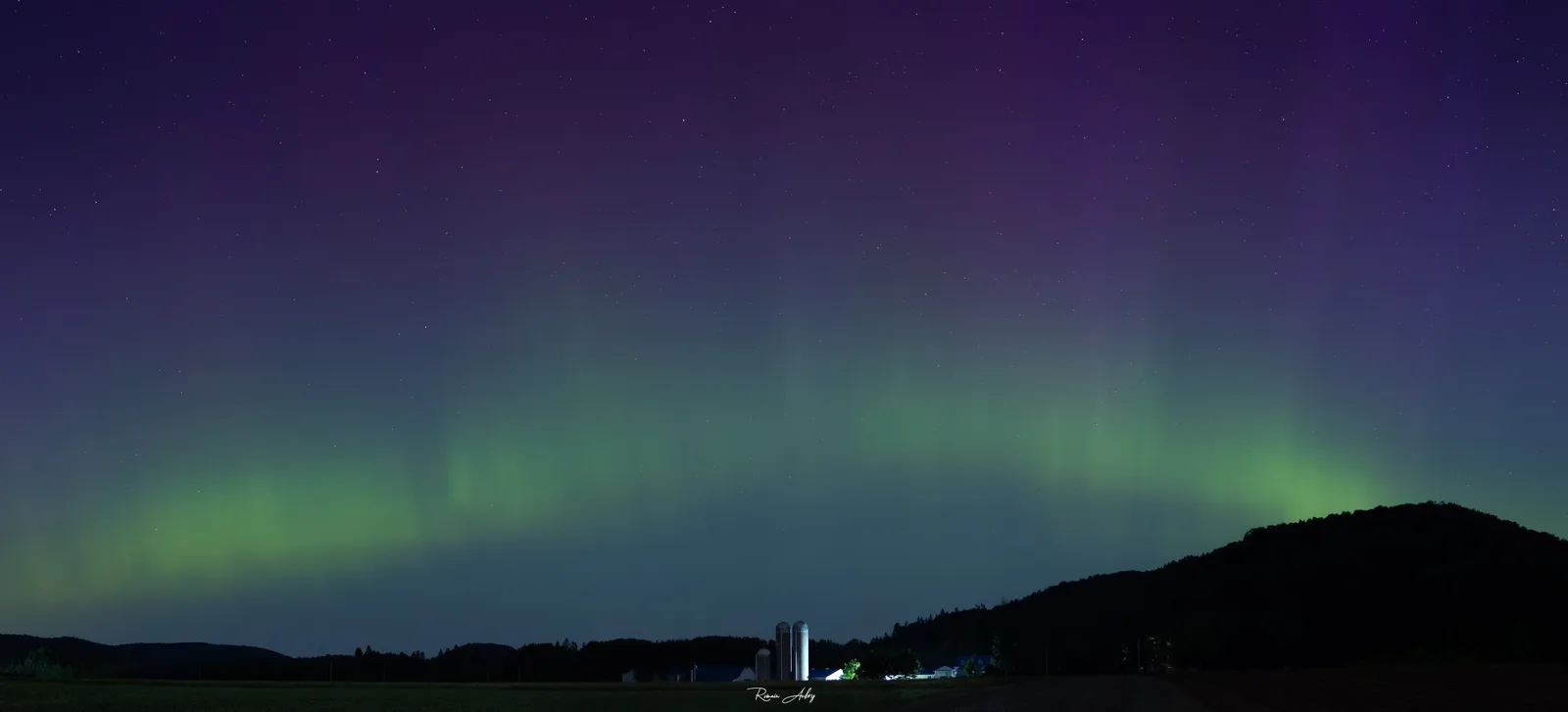
▲ Conditions are for planning only. Dress for the cold, tell someone where you're going, and never take risks to chase a forecast.
05 · Field tips
Your first night out
- Your camera sees more than your eyes. A faint grey smudge to the eye can be vivid green at a 2–10 s exposure. Phone night modes work, and a small tripod helps a lot.
- Let your eyes adjust for 20 minutes. Keep your phone dim (red-light mode if you have it). One glance at a bright screen resets your night vision.
- Be patient and think in substorms. Displays come in waves, and a quiet hour is normal. If Bz is south and the oval is close, stay out.
- Check the whole sky. Faint arcs often sit low on the poleward horizon long before anything is overhead.
06 · Not everything is aurora
STEVE, SAR arcs & the picket fence
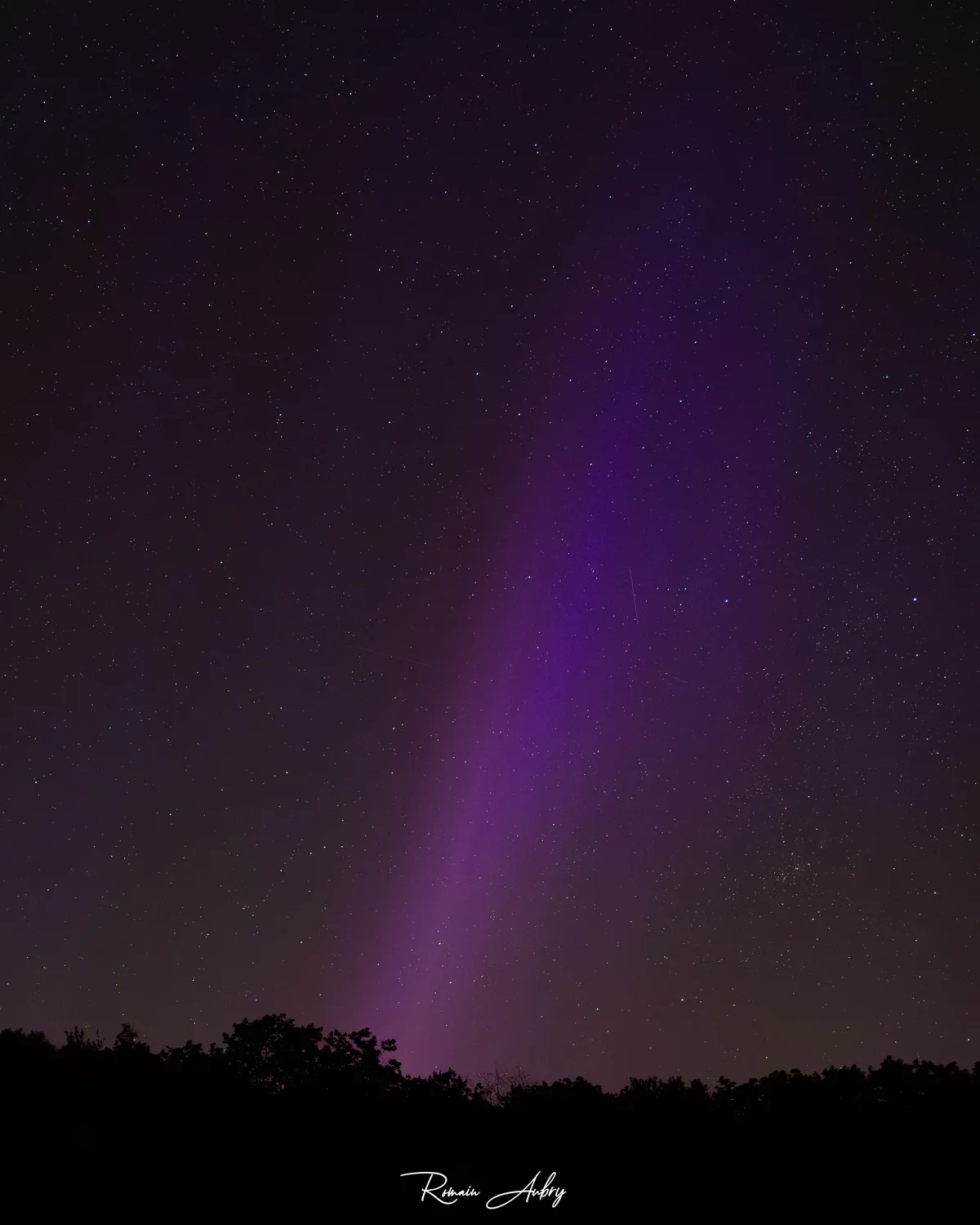
STEVE is a narrow mauve ribbon that runs roughly east–west, closer to the equator than the main oval. It is not classic aurora from falling particles. It is the glow of a hot, extremely fast stream of plasma, and it's often photographed with a green "picket fence" of short vertical stripes beneath it. Faint, deep-red SAR arcs come from ring-current heating during storms and usually only show up on camera. Knowing these helps you name what's in your photos.
07 · Sources & further reading
Go deeper
Aurora photographs: Romain Aubry. Diagrams created for Aurora Core.
Original text written for Aurora Core.